» » Mount Fog - We Know Nothing

Mount Fog - We Know Nothing flac mp3 download
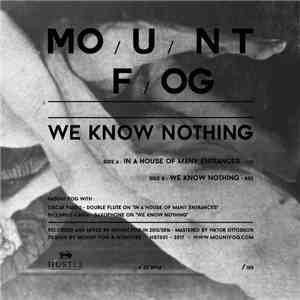
Mount Fog - We Know Nothing flac mp3 download
Title:
We Know Nothing
Musician:
Mount Fog
Style:
Field Recording, Musique Concrète, Experimental
Released:
MP3 album size:
1167 mb
FLAC album size:
1275 mb
Other formats:
AAC MIDI VOX MP1 VQF WAV FLAC
Rating:
4.5 ✪

Download links

Mount Fog - We Know Nothing
MP3 version RAR archive

1275 downloads at 17 mb/s

Mount Fog - We Know Nothing
FLAC version RAR archive

1167 downloads at 19 mb/s

Tracklist Hide Credits

A In A House Of Many Entrances
Flute – Oscar Palou
7:26
B We Know Nothing
Saxophone – Riccardo Canta
8:00

Credits

  • Design, Artwork – Nomoire
  • Design, Artwork, Recorded By, Mixed By – Mount Fog
  • Mastered By – Viktor Ottosson

Notes

Recorded and mixed in 2013/2016.

Hand-numbered edition of 100 copies on transparent clear acetate with printed acetate insert in a printed transparent hand-sewn vinyl sleeve.
Reviews:
  • Mananara
Mount Fog is the name of a trio of artists involved in a variety of media, including photography, graphic design, installation, and sound art: Nicola Domaneschi, Erich Grunewald, and Marco Verdi. We Are Nothing is their first audio publication, and also presented as the first release on the brand-new label Hustle Productions. It is a testament to the continued relevance of both brick-and-mortar stores and well curated distributors alike that I recently stumbled across this release only through the perusal of the excellent Careful Catalog. Even within a small community of like-minded listeners, it seems unlikely I would have found this release in any other fashion. I’m thankful I did.‘In A House Of Many Entrances’ has a logical structure, starting with its opening refrain. We first hear the rustling of random objects and percussion overlaid with some simple tones – formally akin to the tuning of an orchestra prior to its opening movement. Reinforcing the comparison, the sine tone periodically appearing in the opening 30 seconds matches the key of the double flute that follows it, played by Oscar Palou. Interestingly, both seem to me to be between G and G#, and the flute sure enough breaks into a constellation of microtones. These are notes in between those frequencies found on western chromatic scales, and are common to classical Arabic and Indian music as well as early modern classical of western traditions.I know little about the double flute, aside from understanding that they are usually played in a manner reminiscent of other complex pipes or the sitar – one side holds a drone while the other plays a melody. In this case, the microtones could either be a result of technique or a specific tuning of the two pipes. Double flutes are most common in traditional music of the Balkans and India. Though Gour Goswami played the bansuri (which is not a double flute), as with much raga music he certainly incorporated microtones into his renditions. Further, there are similarities between the shruti box providing the drone in raga and the layered drones appearing on ‘In A House…’, one of which even sounds like a bowed sitar.In lieu of finding something to embed, try also comparing it with this track by Ismail Mohammed Khoureissan and Mansour el Qasaba which originally appeared on the 1978 North Yemen compilation in the UNESCO Collection.Though starting with some tactilely interesting electroacoustics, we’ve since mostly had some stylistically pretty, if melodically indebted, music. Keeping things interesting are two main factors. First, the double flute melodies are almost serialist in their chromatic repetitions and variations across the piece. The instrument becomes somewhat buried in the mix which lets it fade out of notice when it harmonically matches the drones, while making its divergences from those patterns jump forward in the listener’s frame. Second, as the piece is nearly overwhelmed by humming mid-range timbres, occasional vocal snippets or the sound of a screeching bowed cymbal (?) provide welcome periodic counterpoints.About five and a half minutes in, however, we get an abrupt break in instrumentation and rhythm. While keeping some of the harmonic elements and bass drone, a rattling drum slowly plods out a beat with a distant electric guitar screech in the background (not dissimilar in tone or timbre to the occasional metallic timbres of the middle few minutes), all of which bleeds into fading vocalisations. Oddly resembling a Sunn O))) track, it manages to instrumentally reinterpret the mood and character of its first section, changing course without losing site of its origin. The sheer diversity of sound sources, styles, and historicity of instrumentation makes for some complex unraveling of meaning for the listener.While listening I briefly considered that once in a ‘house of many entrances’, all the entrances become exits, and that through its vague and undefined character ‘many’ might well become ‘infinite’. Alongside the diversity of its instrumentation and styles, the title and its concept of crossing thresholds (literal and figurative) also brought to mind both the writing of Jorge Luis Borges and One Thousand And One Nights, the latter itself a compendium of stories from different eras and cultures (obviously Persian and Arabic, but also Indian), and further, bearing not one common ending but several different ones depending on the compiler. A more literal point of reference, though one with just as much relevance, would be the Critical Resemblances House by Arakawa and Gins.All in all a decent piece, and rhetorically interesting to boot. However, Mount Fog really come into their own on the eponymous ‘We Know Nothing’. The introduction may remind the listener of the rhythmic elements common to nearly every Senufo release – in this case, some combination of synthetic clicking on a delay line or pedal alongside acoustic contraptions. Part of the attraction to those releases, and present in abundance here, is the anonymity inherent to the sound source’s non-musicality contrasting with the listener’s absolute certainty that it is some completely mundane object that they have in their own house (is that a manual eggbeater? someone repeatedly tapping a USB controller with their index finger?). Given a careful structure and narrative arc, I never tired of the game with Senufo, and it’s just as much fun here.Though the track quickly becomes anchored by saxophone and synthesizer washes, the timbral balance is maintained (to a pleasantly greater degree than the previous track) through continued close-mic-ing of indiscernible objects and fidgeting. The density of the beat and saxophone are negatively correlated, and as the beat slows to a punctuated crawl the saxophone adds louder harmonic elements. This is structurally reminiscent of a magnification of space and its seemingly inevitable link to the slowing of time – akin to the perception of waveforms within a digital audio workstation, mutating from spiky congestions to broadly flowing and ebbing arcs.While ‘In A House…’ had an abrupt instrumental and timbral shift with 2 minutes remaining, a similar change occurs here 2 minutes in. A drum kit begins almost apeing the initial rhythm of the delay line, lending the affair a distinctly post-rock vibe. It is technically a loop, but its attack and decay frequently change while individual components are cut and added back in, as though a basic system of feedback is being used to retrigger itself. The further addition of a bass synthesizer line makes for a dynamically dense soundscape. The background fidgeting continues through it all and I’m unsure of what else to call it – it sounds like a field recording of the studio where the track is being assembled digitally, with squeaking chairs and the acoustic artefacts of picking up and dropping various instruments and objects. Whatever it is, it’s subtle but adds an air of intimacy.Partway through the piece, a field recording of bird calls appears. The calls are interestingly interplayed with the drum rhythms as well as some other complex samples (again the concept of ‘apeing’ or call-and-response seems to be at play here). Further along still a strangely dull piano appears to haltingly accompany the track to its close. I will admit that this everything-and-the-kitchen-sink approach, while part of the fun on the first piece, somewhat broke the spell for me here, as the structure of ‘We Know Nothing’ is otherwise almost crystalline. It ends up verging on musique concrète, simply in terms of its polyphony of sources. I can’t help but feel that it would have benefited from a bit of breathing room, and wonder if its editing was at least partly a result of the limitations of the format.It’s still a wonderful track, and makes We Know Nothing a joy to listen to. While Mount Fog obviously curates its sound collection with great attention to dynamic and rhythmic detail, both halves of this record are a bit too eager to fit as much of that content into their respective durations as possible. Nonetheless, both show great timbral balance and pleasingly cohesive structures. Though it’s their first audio publication, Mount Fog have worked extensively with the medium before, and it shows. Given some refined mastering, and a bit more time to unfold over (maybe a full-length?), I expect, and hope, Mount Fog will surprise us again. Bide your time with this worthwhile release.