» » Debussy -- Boston Symphony Orchestra / Sir Colin Davis - La Mer / Trois Nocturnes

Debussy -- Boston Symphony Orchestra / Sir Colin Davis - La Mer / Trois Nocturnes flac mp3 download
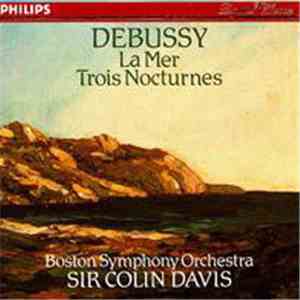
Debussy -- Boston Symphony Orchestra / Sir Colin Davis - La Mer / Trois Nocturnes flac mp3 download
Title:
La Mer / Trois Nocturnes
Musician:
Style:
Impressionist
Released:
Country:
MP3 album size:
1883 mb
FLAC album size:
1275 mb
Other formats:
WMA AAC MIDI AIFF MP4 AA AC3
Genre:
Rating:
4.5 ✪

Tracklist

La Mer
1. De L'Aube A Midi Sur La Mer 9:21
2. Jeux De Vagues 6:26
3. Dialogue Du Vent Et De La Mer 8:08
Nocturnes
1. Nuages 7:59
2. Fêtes 6:38
3. Sirènes 12:13

Versions

Category Artist Title (Format) Label Category Country Year
411 433-2 Debussy* -- Boston Symphony Orchestra / Sir Colin Davis Debussy* -- Boston Symphony Orchestra / Sir Colin Davis - La Mer / Trois Nocturnes ‎(CD, Album) Philips Classics 411 433-2 Germany Unknown
6514 260 Debussy* - Boston Symphony Orchestra, Sir Colin Davis Debussy* - Boston Symphony Orchestra, Sir Colin Davis - La Mer & Trois Nocturnes ‎(LP) Philips 6514 260 France 1982
6514 260 Debussy* – Boston Symphony Orchestra, Sir Colin Davis Debussy* – Boston Symphony Orchestra, Sir Colin Davis - La Mer / Trois Nocturnes ‎(LP) Philips 6514 260 Europe 1982
411 258-1, 53 Debussy* – Boston Symphony Orchestra, Tanglewood Festival Chorus, Sir Colin Davis Debussy* – Boston Symphony Orchestra, Tanglewood Festival Chorus, Sir Colin Davis - La Mer / Nocturnes ‎(LP) Philips, De Klassieken 411 258-1, 53 Europe 1984
Reviews:
  • heart of sky
nocturnes..i've often opined that debussy's orchestral work is the greatest music ever written, or at the very least a close second to beethoven's.you want to float off into some netherworld? well, it's in here. you want to invade germany? well, that's in here too. it may seem odd to think of france invading germany, but when this was written the monster of history was napoleon and not hitler and even the first world war had yet to truly be imagined. the war was the french revolution. nobody's going to get the reference of german music being inferior because it just makes you want to invade france, anyways.this little collection of songs somehow defies time. nuages is eight minutes long but it always seems like two; fetes is seven, but it feels like fifteen and sirenes is twelve but it feels like twenty-five. so, it balances out by making up the time that it somehow manages to steal but it only does so if you listen to all of it.i can't speak for other recordings, but this one sounds best through headphones as the horizontal complexity in the music (which is the defining point when it comes to debussy) is most audible that way.it's easy to understand how the novel approach that debussy brought to music composition is lost amongst younger listeners because it's been so widely adopted, especially amongst the creators of psychedelic/progressive rock, ambient music and noisy jazz. younger listeners should understand that debussy is the true architect of space rock; older listeners should recognize that pink floyd is his natural heir. while a reading of the development of music theory through the nineteenth century is purely about deconstructing the crowning achievement of the era of classical music, and it cannot be stressed enough that this ended before the death of beethoven, the approach up until debussy was always solely academic, written and theoretical. sure, it was a move away from theory, a discarding of perfection and an admittance that imperfection is a better way to describe reality than perfection. yet, romantic music was still based upon theory and still written around it's limitations; it was a slow, incremental progression.debussy tore it all apart. theory? he didn't need no stinking theory. every transition was independent of the next, with nothing but utter contempt for causality, tradition or expectation. overtones and harmonics bled into new phrases in ways that would have made mozart cringe, which is what made debussy smile. punk rock? yes, absolutely. stories? themes? movements? forget it. what you get instead are dreams, emotions, paintings and abstract thoughts.in hindsight, many have analyzed debussy's writing in an attempt to come up with an underlying theory, completely missing the point of his compositional style. certainly, if you study his works you're going to pull out various patterns that he liked to use but using the same patterns repeatedly doesn't suggest the existence of an underlying theory. that argument is logically specious and comparable to the "theory" of intelligent design.i find this particular collection works best under one of three circumstances. first, it's nice music to listen to while relaxing in a park on a summer night and sparking one up. second, it works well as something to do once you've come home from a night of partying and need to escape into a netherworld as you come down from whatever your vice happens to be. third, it works well for background music while studying.
  • salivan
la mer...this is once again headphone music, unless you can find a totally silent room somewhere in the middle of an abandoned corn field in which to listen to it. today, we have whirs and buzzes coming from every which way. you won't hear the subtlety in the writing over the hum of your fridge and the passing cars and planes unless you've turned the stereo up so loud that your neighbours are forced to bang on your door and tell you to turn down the racket. it's the shifts in dynamics that necessitate the volume; half the piece is played at a whisper amongst a handful of instruments while the other half is at a decibel level that would force stuart braithwaite to cover his ears.ok, i'm exaggerating. still....use headphones.the piece is disorienting, which is what you'd have to expect from a concept record about the ocean. on the surface, you have tranquility conflicting with chaos. yet, below the illusion of tranquility is the chaotic and often violent behaviour of a complicated ecosystem, each instrument interested in only it's own existence and it's own survival. does it come out sounding awkward at points? it would have to. often, the oboe doesn't seem to know what the trumpet is up to but if it ever had the chance to muffle it for it's own purposes it would do so without thinking twice about it; it would carry no shame about it afterward. flutes should perpetually be on the lookout for predatory timpani. and, of chaos? well, it's not all violence and destruction. increasing structure actually sounds like it's correlated with rising volume. one would have to analyze the score to determine whether or not the underlying complexity is simply being drowned out.i would expect that many people today would write this off after the first or second listen as a lot of quiet, boring randomness punctuated by a few massive crescendos. certainly, the crescendos are nice but they're only 20 seconds long each. where's the action? is it really necessary to listen to ten minutes of harps and bassoons fading in and out of each other to get to the climax at the end of each movement? why not release a record consisting only of crescendos, cutting out all of the useless filler in the middle? it would be like a greatest hits record. they'd sell 20 million copies.such is the effect of television on the masses, a pandemic of self-induced ADD. the point, of course, is to enjoy and explore the ten minutes of complexity that lead to the climax. the climax may be the afterthought that makes the first ten minutes worthwhile, but it's the first ten minutes that make the piece worth listening to. the climax itself is ultimately even meaningless without the context of what flows before it. it's the rise and build that makes the climax the climax! without a build, a climax is just a lot of volume and maybe a simple melody.most people won't hear it like that.so, i can't recommend this to anybody that won't learn about it in music class anyways.
Related Debussy -- Boston Symphony Orchestra / Sir Colin Davis - La Mer / Trois Nocturnes mp3 / flac albums: